What Is Digital Marketing and How Can It Help a Small Business Generate More Leads and Sales?

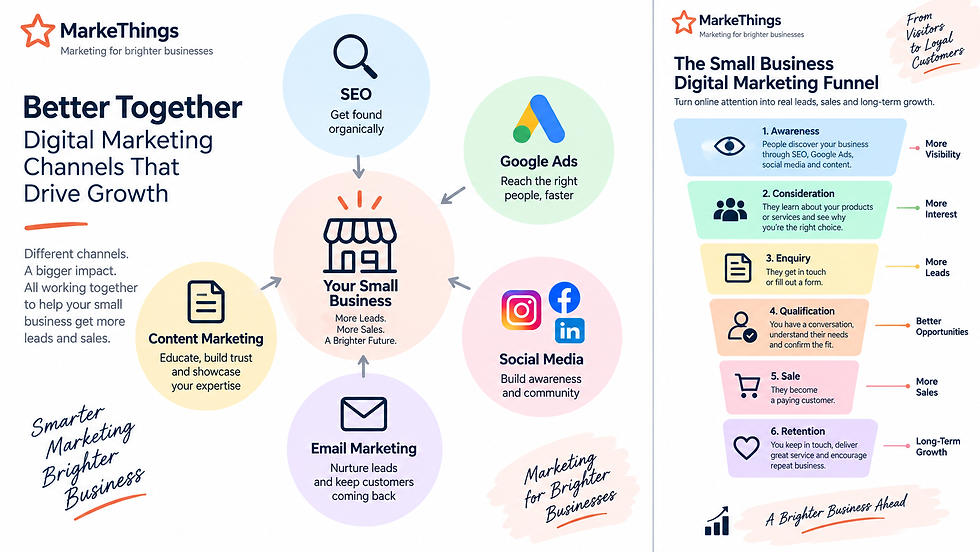
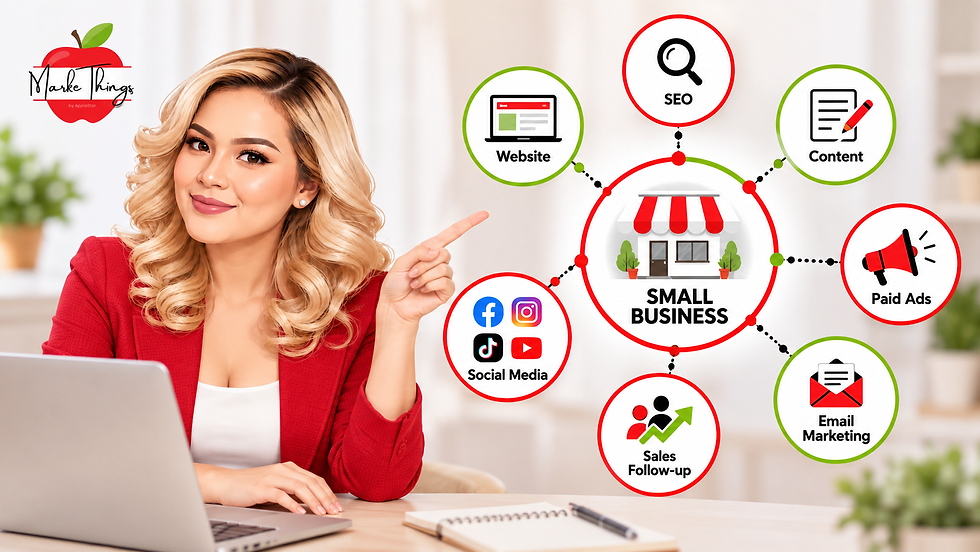
Digital marketing is the use of online channels, platforms and tools to promote a business, attract potential customers, generate enquiries and support sales. For a small business, it can connect search engines, websites, social media, advertising, content, email and follow-up into one customer journey rather than a collection of disconnected marketing tasks.

At MarkeThings, I look at digital marketing slightly differently from simply asking, "How often are we posting?"
The more useful question is:
Is the marketing helping the business attract the right people, turn interest into enquiries, and turn suitable enquiries into customers?
That is where digital marketing becomes a business system rather than just another thing sitting on your weekly to-do list.
Quick Answer: What Is Digital Marketing?
Digital marketing is marketing delivered through digital channels such as search engines, websites, social media, online advertising, email and digital content.
For a small business, digital marketing can help:
Get discovered by potential customers.
Build trust through useful content and a professional online presence.
Generate enquiries through websites, forms, calls, messages and bookings.
Nurture leads through email, follow-up and remarketing.
Support sales by giving prospects the information they need to make a decision.
Measure performance so the business can see which activities contribute to meaningful outcomes.
The important part is that these activities work better when they are connected.
Why Does Digital Marketing Matter for Small Businesses?
Small businesses rarely have unlimited time, money or people.
That makes prioritisation important.
A business might have a website, Facebook page, Instagram account, Google Ads campaign and email list, but that does not automatically mean the marketing is working as a system.
The Australian Government recommends starting with a clear digital strategy that identifies the target audience, digital goals, appropriate channels, resources and ways to measure success.
For example, imagine a small consulting business.
Someone discovers the business through Google.
They visit the website.
They read an article answering a problem they are experiencing.
They see a clear service page.
They submit an enquiry.
The business follows up promptly.
The prospect books a consultation.
That is digital marketing supporting a sales journey.
It is much more useful than simply saying, "Our blog received 500 views."
Digital marketing is not just about getting attention
Attention can be useful, but attention is not the final commercial outcome.
A small business needs to understand what happens after someone discovers the brand.
That means looking at the journey from:
Visibility → Visit → Engagement → Enquiry → Qualified Lead → Sales Opportunity → Customer
Not every person will move through every stage, and that is normal.
The job of marketing is to improve the system, not pretend that every website visitor is about to become a customer.
💡 Helpful insight: If your marketing report celebrates impressions but nobody can explain how those activities connect to enquiries or sales, you probably need to look further down the funnel.
How Does Digital Marketing Generate More Leads?
Lead generation means attracting and capturing people who may be interested in your product or service.
MarkeThings describes lead generation as more than getting somebody to submit a form. The process also needs to consider what happens before, during and after the enquiry.
There are several ways digital marketing can contribute.
1. SEO helps people find you when they are searching
Search engine optimisation, or SEO, improves a website's ability to be discovered through relevant search queries.
For example, a local electrician might want to appear when potential customers search for:
emergency electrician
electrician near me
electrical repairs
switchboard upgrades
residential electrician
The exact opportunities depend on the business, market, competition and customer behaviour.
SEO can include:
Keyword research
Search-focused content
On-page optimisation
Technical improvements
Local SEO
Internal linking
Helpful blog content
Conversion-focused service pages
The important distinction is that SEO should not simply chase traffic.
A thousand visitors who have no interest in your offer may be less commercially useful than a smaller number of visitors who are genuinely looking for what you sell.
2. Paid advertising can capture existing demand
Paid search advertising can place a business in front of people actively searching for relevant products or services.
Google explains that Search campaigns can be used to pursue goals such as sales, leads or website traffic and can target relevant search terms.
For example, someone searching for "accountant for small business Sydney" already has a problem or requirement.
A relevant advertisement can put a business in front of that person at an important point in the buying journey.
But paying for clicks does not automatically create sales.
The advertisement, landing page, offer, targeting, tracking and sales follow-up all matter.
3. Social media can create awareness and trust
Social media can help businesses connect with customers, promote products or services, build trust and drive website traffic.
For some businesses, social media may be particularly useful for:
Demonstrating expertise
Showing products
Answering customer questions
Sharing educational content
Building familiarity
Starting conversations
Retargeting interested audiences
The right platform depends on where the target customers actually spend time.
You do not need to be everywhere.
One or two channels managed properly can be more practical than trying to maintain six platforms badly.
4. Content answers questions before people contact you
Content marketing helps potential customers understand a problem and evaluate possible solutions.
That could include:
Blog articles
Guides
FAQs
Videos
Case studies
Comparison pages
Educational social posts
Downloadable resources
Good content can answer questions that salespeople would otherwise have to answer repeatedly.
For example:
"How much does bookkeeping cost?"
"Do I need SEO if I already use Google Ads?"
"How long does a website redesign take?"
"What should I prepare before hiring a marketing team?"
The content should not hide the answer behind seven paragraphs of waffle.
Give people the useful answer first.
They have things to do.
So do you.
How Does Digital Marketing Turn Leads Into Sales?
Generating leads is only half the job.
A business can have plenty of enquiries and still struggle to generate sales if the customer journey is confusing or follow-up is inconsistent.
Consider this simple example:
Stage | What happens | Useful metric |
Discovery | Customer finds the business | Search visibility, reach |
Visit | Customer explores the website | Website visits, engagement |
Enquiry | Customer contacts the business | Enquiries |
Qualification | Business assesses fit | Qualified leads |
Opportunity | Prospect enters sales process | Sales opportunities |
Sale | Customer purchases | Closed sales |
Retention | Customer returns or recommends | Repeat business |
The exact metrics will vary by business.
A service business may care about calls and consultation bookings.
An ecommerce business may care about purchases and customer lifetime value.
A clinic may care about suitable appointment enquiries.
A recruitment business may care about qualified employer opportunities.
The measurement system should reflect the actual business model.
The sales process matters too
Marketing cannot compensate indefinitely for a broken sales process.
If leads are coming in but nobody responds promptly, the problem may not be the advertising campaign.
If people visit the website but cannot understand the offer, the problem may be conversion.
If prospects enquire but never receive a useful follow-up, the business may need a better sales or CRM process.
Google's current guidance also emphasises connecting advertising measurement to deeper stages such as qualified leads and converted leads rather than stopping at initial lead volume.

💡 Helpful insight: A lead is not the same thing as a sale. Track the journey far enough to understand which leads become qualified opportunities and which ultimately become customers.
Which Digital Marketing Channels Should a Small Business Use?
There is no universal channel combination that works for every business.
A sensible starting point is to identify the business objective first.
Business goal | Potential digital channels |
Increase search visibility | SEO, local SEO, content |
Generate immediate enquiries | Google Ads, landing pages |
Build trust | Content, social media, website |
Nurture leads | Email marketing, CRM, automation |
Re-engage interested prospects | Retargeting, email |
Increase repeat purchases | Email, customer marketing |
Improve conversion | Website optimisation, landing pages |
Build long-term authority | SEO, content, expert-led publishing |
The important word is potential.
A business does not need every channel simply because the channels exist.
SEO vs paid ads
SEO and paid search can support the same business goal in different ways.
SEO | Paid Ads |
Focuses on organic search visibility | Buys advertising exposure |
Can support long-term visibility | Can provide faster access to search demand |
Requires content and optimisation | Requires advertising budget |
Results depend on competition and search behaviour | Results depend on targeting, offer, ads, landing page and budget |
Useful for building search presence | Useful when immediate search visibility is important |
They can also work together.
Paid advertising can help identify useful search terms and offers, while SEO can build organic visibility around valuable topics.
What Role Does the Website Play?
Your website is often where marketing activity becomes a commercial opportunity.
Someone may discover your business through Google, Instagram, Facebook, LinkedIn, an advertisement or a recommendation.
The website then needs to answer basic questions quickly:
What do you do?
Who do you help?
What problem do you solve?
Why should someone trust you?
What happens next?
How can they contact you?
A website does not need to win a design award.
It needs to make sense.
A useful website should make it easy for people to understand the offer and take the appropriate next step. MarkeThings similarly positions website optimisation around explaining the offer, establishing trust and making the desired action clear.
💡 Helpful insight: Before spending more money sending people to your website, ask whether the website gives those people a clear reason and easy way to continue.
Can Email Marketing Help Generate Sales?
Yes. Email marketing can help businesses nurture leads, stay connected with existing customers and support repeat sales.
It is particularly useful when someone is interested but not ready to buy immediately.
For example:
Day 1: Someone downloads a guide.
Day 3: They receive a useful explanation of the problem.
Day 7: They receive an example or educational resource.
Day 12: They receive an invitation to book a consultation.
Automation can also help with reminders, lead follow-up and repetitive communication. Australian Government guidance notes that marketing automation can coordinate activities across channels and automate repetitive tasks such as follow-ups and reminders.
However, businesses need to follow applicable rules when sending commercial electronic messages and handling customer information. Australian businesses should check the relevant requirements before implementing campaigns.
How Should a Small Business Measure Digital Marketing?
This is where the conversation needs to move beyond likes.
A practical measurement system might include:
Marketing activity → Leads → Qualified leads → Sales opportunities → Customers → Revenue
Depending on the business, useful metrics may include:
Website enquiries
Phone calls
Booking requests
Cost per lead
Lead-to-opportunity conversion
Opportunity-to-sale conversion
Customer acquisition cost
Revenue influenced by marketing
Repeat purchases
Time from enquiry to conversion
Not every metric needs to be reported every week.
The goal is to understand what is happening well enough to make better decisions.
Google Ads, for example, provides tools for tracking actions such as clicks and valuable downstream actions.
What Are the Most Common Digital Marketing Mistakes Small Businesses Make?
1. Trying to be everywhere
A business launches Facebook, Instagram, TikTok, LinkedIn, YouTube, email and a blog simultaneously.
Three weeks later, everyone is exhausted.
Start with the channels most relevant to your audience and business model.
2. Measuring attention instead of outcomes
Reach and impressions can provide useful context.
They are not automatically sales.
3. Running ads before fixing the offer
If the offer is unclear, advertising can simply send more people to an unclear offer.
4. Publishing without a strategy
Content should answer customer questions, support search visibility, build trust or help the sales journey.
Posting simply because Tuesday is "content day" is not a strategy.
5. Ignoring follow-up
A lead that receives no response is not a successful marketing outcome.
6. Expecting instant SEO results
SEO can be valuable, but search visibility depends on factors including competition, website quality, content relevance, authority, demand and search engine changes.
7. Treating every lead as a good lead
More leads are not necessarily better if they are unsuitable, unqualified or impossible for the business to serve.
💡 Helpful insight: If you want more sales, don't automatically start by asking, "How do I get more traffic?" Ask, "Where is the current customer journey losing people?"
Is Digital Marketing Worth It for a Small Business?
Digital marketing can be valuable for a small business when it is connected to a clear commercial objective and measured appropriately.
It is less useful when a business spends money on channels without knowing:
Who it is trying to reach
What it is offering
Why customers should care
What action customers should take
How enquiries are followed up
How performance is measured
The Australian Government's guidance similarly recommends setting digital goals, choosing appropriate channels and deciding how success will be measured.
The right question is therefore not simply:
"Should I do digital marketing?"
It is:
"Which digital marketing activities solve my current business problem?"
That is a much more useful question.
Should You Hire a Digital Marketing Agency, VA or Remote Marketing Team?
It depends on the work you actually need.
Option | May suit a business that needs |
Marketing VA | Consistent execution of defined marketing tasks |
Specialist freelancer | A specific skill or project |
Remote marketing team | Multiple connected marketing activities |
Consultancy | Strategy, diagnosis and direction |
In-house team | Ongoing internal marketing ownership |
The options are not mutually exclusive.
A small business might use a consultant for strategy, a remote marketing team for execution and internal staff for sales.
MarkeThings takes a connected approach, combining digital marketing activities around the customer's journey rather than treating every channel as an isolated task.
For businesses considering VA support, the Digital Marketing VA Starter Kit can also help clarify the difference between basic task support and results-focused digital marketing assistance.
How Can a Remote Marketing Team Help a Small Business?
A remote marketing team can help a business access marketing capability without requiring every task to be performed by one internal employee.
This can be particularly relevant for SMEs in Australia, New Zealand, Singapore, the United Kingdom, Dubai, the UAE and other international markets.
The important consideration is not simply whether the team is remote.
It is whether communication, responsibility, systems, security, reporting and quality control are clear.
MarkeThings uses a remote model to support businesses across these markets while adapting marketing activity to the relevant business, audience and market context.
A remote arrangement should still feel organised.
You should know:
Who is responsible for strategy?
Who executes the work?
What gets reported?
How are approvals handled?
Where is customer information stored?
How are leads handed over?
How often are priorities reviewed?
Remote should mean flexible, not mysterious.
What Should a Small Business Do First?
If your marketing feels scattered, start with the fundamentals.
Step 1: Define the customer
Identify your most commercially relevant audience.
Step 2: Clarify the offer
Make sure people can quickly understand what you sell and why it matters.
Step 3: Check your website
Look for unclear messaging, weak calls to action, missing information and unnecessary friction.
Step 4: Identify your strongest acquisition opportunity
This might be SEO, paid search, social media, partnerships, content, email or another channel.
Step 5: Set up lead tracking
Know where enquiries come from and what happens after they arrive.
Step 6: Improve follow-up
Create a consistent process for responding to enquiries.
Step 7: Measure commercial outcomes
Connect marketing activity with qualified leads, opportunities and sales wherever practical.
Step 8: Optimise before adding more
You do not necessarily need another platform.
Sometimes you need to fix the system you already have.
How MarkeThings Approaches Digital Marketing
At MarkeThings, digital marketing is treated as a connected growth system.
The relevant services can include:
SEO
Google Ads
Meta Ads
Social media marketing
Content marketing
SEO blog writing
Email marketing
Lead generation
Website optimisation
Marketing automation
Analytics and conversion tracking
The current MarkeThings service approach is to connect these activities around the same customer journey and business objective.
The process starts with understanding the problem rather than automatically selling every available service.
That can mean auditing the website, campaigns, visibility, customer journey and tracking first, then deciding what deserves attention.
This is particularly important for small businesses.
Your budget deserves a job description.
AppleStar's Take
I don't think small businesses need more marketing for the sake of having more marketing.
They need marketing that makes sense.
If your website is generating traffic but not enquiries, investigate conversion.
If you are getting enquiries but poor-quality leads, investigate targeting and messaging.
If you are getting good leads but losing them during follow-up, investigate the sales process.
If nobody is finding you in search, investigate SEO and content.
If you need enquiries sooner, paid advertising may deserve consideration.
The point is to diagnose the bottleneck before throwing another channel at it.
Marketing should support sales, customer growth and revenue.
Likes are nice.
They just don't pay the electricity bill.
Final FAQs
What is digital marketing in simple terms?
Digital marketing is the use of online channels such as search engines, websites, social media, advertising, email and content to attract, engage and convert potential customers.
How can digital marketing generate leads?
Digital marketing can generate leads by helping potential customers discover a business, understand its offer and take an action such as calling, submitting a form, booking an appointment or sending a message.
Can digital marketing increase sales?
Yes, digital marketing can support sales by attracting relevant prospects, building trust, generating enquiries, nurturing leads and improving conversion. Actual sales outcomes depend on the offer, market, customer journey, execution, competition and sales process.
How long does digital marketing take to work?
There is no universal timeline. Paid campaigns can begin generating measurable activity relatively quickly, while SEO and content often require longer-term optimisation and development. Results vary by market, competition, website condition, strategy and execution.
How much does digital marketing cost?
There is no single appropriate price for digital marketing. Cost depends on the business's goals, market, channels, campaign complexity, competition and level of support required.
Should a small business focus on SEO or paid ads?
It depends on the business objective. SEO can support longer-term organic visibility, while paid search can provide access to people actively searching for relevant products or services. Many businesses can use both as part of a broader strategy.
Can social media generate leads for a small business?
Yes, social media can contribute to lead generation by building awareness, trust and conversations and by directing relevant audiences towards websites, offers or enquiries. The appropriate platform depends on where the target audience is active.
Is a marketing VA enough for a small business?
Sometimes. A marketing VA can be suitable when a business has clearly defined tasks that need consistent execution. Businesses needing strategy, multiple channels, specialist skills and integrated campaigns may require broader support.
Can a remote marketing team support businesses in Australia?
Yes. A remote marketing team can support Australian businesses when responsibilities, communication, systems, security and reporting are clearly managed. The marketing strategy should still reflect the Australian market and the specific business.
How do I know whether my digital marketing is working?
Track the journey from marketing activity to enquiries, qualified leads, sales opportunities and customers. The right metrics depend on your business model, but the goal is to connect marketing activity with meaningful business outcomes.
What should I do if my marketing generates leads but not sales?
Investigate lead quality, offer clarity, website conversion, sales follow-up, response times and the qualification process before simply increasing traffic or advertising spend.
Should I hire a digital marketing agency?
Consider external support when marketing is disconnected, your internal team lacks the required capacity or skills, or you need a clearer strategy and implementation system. The right provider should first understand the business problem before recommending services.
A Practical Next Step for Your Business
If you are unsure where your digital marketing is losing potential customers, start with the customer journey rather than another social media post.
Review:
Who finds you → why they click → what they see → how they enquire → how quickly you respond → how they become qualified → how they become customers.
If you want help identifying the gaps, explore MarkeThings' digital marketing services or start with the available marketing audit and proposal option on the MarkeThings website.
The objective is not to make your business look busy online.
It is to build a marketing system that helps the right people find you, trust you, contact you and move towards a buying decision.
AUTHOR
Apple Star Salvador, known professionally as AppleStar, is the Digital Marketing Professional and Omnichannel Growth Strategist behind MarkeThings by AppleStar. She focuses on connecting digital marketing, customer acquisition, conversion, retention, sales and operations into practical business systems.
SOURCES
Australian Government, business.gov.au, Marketing.
Australian Government, business.gov.au, Develop your digital strategy.
Australian Government, business.gov.au, Digital tools for business.
Australian Government, business.gov.au, Social media for business.
Google Ads Help, Create a Search campaign.
Google Ads Help, Best practices for generating high-quality leads.
MarkeThings, Digital Marketing Services.
MarkeThings, Digital Marketing FAQs.


Comments