What Digital Marketing Services Does a Small Business Actually Need?

Digital marketing services for small business should not mean signing up for every marketing channel available.
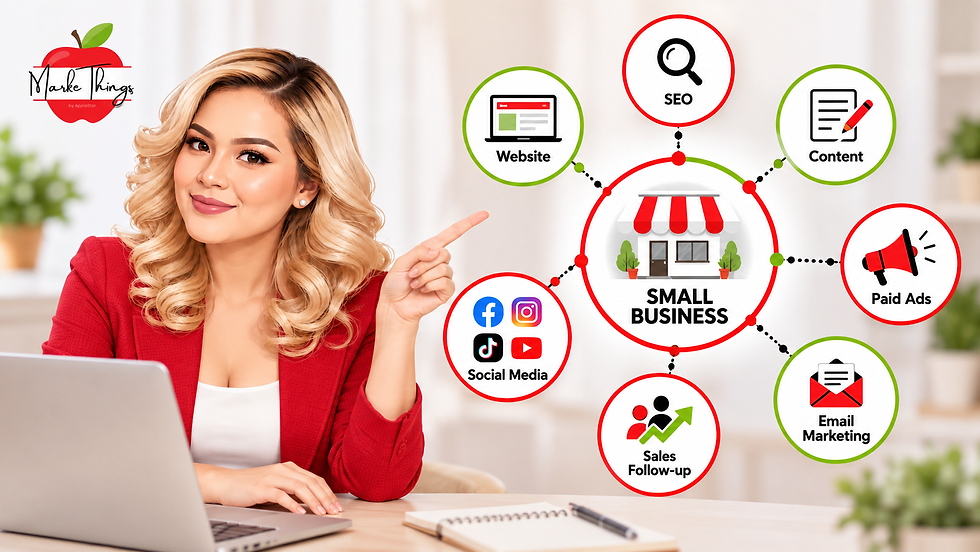
For most small businesses, the priority is to build a simple system that helps the right people find you, understand what you offer, contact you, and eventually become customers. That usually means getting the foundation right first, then adding the channels that match your audience, offer, budget and sales process.
The goal is not to have the busiest Facebook page on the internet. It is to have marketing that actually supports the business.
And yes, your marketing calendar can survive without posting a motivational quote every Tuesday.
Quick Answer: What Digital Marketing Services Does a Small Business Actually Need?
Most small businesses need five core capabilities:
A strong website and conversion foundation
SEO and local search visibility
One or two customer acquisition channels, such as Google Ads, Meta Ads or social media
Content and email marketing to build trust and follow up with prospects
Analytics, lead tracking and sales follow-up so you know what is actually producing business
Not every business needs every service immediately.
A local trades business may need local SEO, a strong Google Business Profile and lead follow-up before it needs a sophisticated social media strategy. A B2B consultant may prioritise SEO, LinkedIn content, lead generation and email. An ecommerce brand may need paid ads, product content, email automation and conversion optimisation.
The right question is not, "What marketing services can I buy?"
It is:
"What is currently stopping my business from getting more qualified customers?"
Key Takeaways
You do not need every digital marketing service at once.
Your website, offer and conversion process should provide the foundation.
SEO helps people discover you through search, particularly when your audience is already looking for your service.
Paid advertising can create faster traffic, but it needs a sensible offer, landing page and follow-up process.
Social media is useful when your customers actually use the platform and your business has something worth communicating.
Content should answer customer questions and support SEO, social media, sales and trust.
Email gives you a way to continue communicating with people who have already opted into your audience.
Analytics and lead tracking connect marketing activity to business outcomes.
A remote marketing team or marketing virtual assistant can help execute recurring work without requiring a large in-house team.
The best starting point is usually a focused combination of services, not a giant marketing package.

What Should a Small Business Fix Before Spending More on Marketing?
Before investing heavily in traffic generation, make sure your basic customer journey works.
A visitor should be able to answer these questions quickly:
What does this business do?
Who is it for?
Why should I consider it?
What problem does it solve?
What should I do next?
How do I contact or buy from the business?
If those answers are unclear, increasing traffic can simply increase the number of people who leave.
Your website is part of your marketing
Your website does not need to be enormous.
It does need to communicate the offer clearly, work properly on mobile devices, provide useful information and make the next action obvious.
For a service business, that action might be:
Request a quote
Book a consultation
Call
Send an enquiry
Complete a form
For ecommerce, it might be:
View a product
Add to cart
Purchase
Join an email list
For a professional service, it may be downloading a useful resource or booking an initial conversation.
Marketing traffic and conversion should be considered together.
💡 Helpful insight: If your website cannot explain what you sell in a few seconds, spending more money to send people there is unlikely to solve the underlying problem.
Does a Small Business Need SEO?
Usually, yes, particularly when customers use search engines to find the products or services you provide.
SEO, or search engine optimisation, is the process of improving your website and online presence so relevant people can discover your business through search.
SEO can include:
Keyword research
On-page SEO
Technical SEO basics
Local SEO
Helpful website content
SEO blog writing
Internal linking
Search-focused content planning
Authority and link-building activities where appropriate
For local businesses, Google Business Profile can also be important. Google says businesses should keep information such as their business category, hours and location accurate and complete, and it highlights reviews, photos and videos as useful parts of the profile.
Not every business needs an aggressive SEO programme.
But if potential customers search for the problem you solve, ignoring search visibility can mean leaving an important discovery channel underdeveloped.
SEO vs paid ads
SEO and paid search solve related but different problems.
SEO | Paid Ads |
Builds organic visibility | Buys advertising visibility |
Usually takes time to develop | Can generate traffic more quickly |
Content and website improvements can compound | Requires ongoing advertising spend |
Useful for long-term search visibility | Useful when you need targeted traffic |
Can support topical authority | Can target specific campaigns and offers |
The two can also work together.
Search data from advertising can help inform content decisions, while strong organic pages can provide useful destinations for paid campaigns.
Does Every Small Business Need Social Media Management?
No. A business needs social media where its customers are, not simply because competitors are posting there.
Social media management may include:
Content planning
Copywriting
Graphic or visual content
Video content planning
Scheduling
Community management
Comment responses
Campaign support
Performance reporting
The mistake is treating social media as a box that needs to be ticked every day.
A better approach is to decide what social media needs to accomplish.
For example:
Business goal | Possible social media role |
Build awareness | Educational and brand content |
Build trust | Expertise, testimonials and behind-the-scenes content |
Generate enquiries | Offers, lead magnets and calls to action |
Support sales | Product demonstrations and FAQs |
Retain customers | Updates, education and community |
If your ideal customers rarely use a particular platform, being extremely consistent there may not produce much business value.
When Does a Small Business Need Paid Ads?
Paid advertising can make sense when you have a clear offer, a defined audience and a way to measure enquiries or sales.
Common options include:
Google Ads
Meta Ads
Social advertising
Display advertising
Retargeting campaigns
Google's own guidance explains that businesses can use Google advertising to reach people across Google properties, depending on the campaign and eligibility.
Paid ads can be useful when you want to:
Promote a specific offer
Generate enquiries
Reach people actively searching for a service
Test demand
Support a product launch
Retarget people who have already interacted with your business
But advertising is not a repair kit for a broken sales process.
If your landing page is unclear, your offer is weak or nobody follows up with leads, more clicks will not magically fix those problems.
💡 Helpful insight: Think of paid advertising as an accelerator. Before pressing the accelerator, make sure the vehicle has wheels.
Why Content Marketing Still Matters
Content marketing is about creating useful information that helps attract, educate and support potential customers.
That could include:
Blog articles
Guides
FAQs
Case-study-style educational content
Videos
Social posts
Email content
Website resources
Good content answers questions people are already asking.
For example, a bookkeeping business could create content about preparing records for tax time. A business consultant could explain common growth bottlenecks. A trades business could answer questions about choosing between repair and replacement.
Content can then be reused across the marketing system.
One useful article might become:
A blog post
Several social posts
An email
A sales resource
An FAQ
A topic for a short video
That is much more useful than creating six disconnected pieces of content because the calendar says you need six.
Does a Small Business Need Email Marketing?
If you have customers or prospects who have opted into communication, email can be a valuable retention and follow-up channel.
Email marketing can support:
Lead nurturing
Customer retention
Promotions
Education
Product updates
Appointment reminders
Re-engagement
Automated sequences
The important distinction is between building an owned audience and simply renting attention from advertising platforms.
A small business with a useful, permission-based email list has an ongoing communication channel it can develop over time.
Email automation can also reduce repetitive manual work.
For example:
New enquiry → welcome email → useful resource → follow-up → sales conversation
The exact sequence depends on the business and the customer journey.
What About Lead Generation and Sales Support?
Marketing should not stop when somebody fills in a form.
Lead generation is about attracting potential customers. Sales support helps make sure those opportunities are handled properly.
That may include:
Lead capture
CRM support
Outreach
Sales funnel support
Lead qualification
Follow-up processes
Appointment support
Reporting
This is where marketing and sales need to stop behaving like distant relatives who only see each other at weddings.
If marketing generates enquiries but nobody responds promptly, the business can lose opportunities even when the marketing campaign itself is performing as expected.
What Marketing Services Should a Small Business Outsource First?
There is no universal order, but repetitive and specialist tasks are often practical candidates for outsourcing.
Task | Why outsourcing may help |
Social media scheduling | Recurring and time-consuming |
Content production | Requires consistent execution |
SEO implementation | Specialist knowledge and ongoing work |
Blog writing | Requires research and editorial consistency |
Paid ads management | Requires monitoring and optimisation |
Email campaigns | Recurring setup and execution |
Lead research | Can consume significant founder time |
CRM updates | Important but often repetitive |
Reporting | Helps turn activity into useful decisions |
Admin support | Frees owners for higher-value work |
A marketing virtual assistant can be useful for execution-heavy work. A specialist or strategist may be more appropriate for work involving technical decisions, campaign strategy or complex optimisation.
That distinction matters.
You do not necessarily need an "agency" for every task, but you also should not hand a highly specialised marketing problem to someone simply because they are available.
Marketing VA vs Digital Marketing Team: What Is the Difference?
A marketing virtual assistant typically supports defined operational tasks.
A broader remote marketing team can provide a combination of strategy, execution and specialist support.
Marketing VA | Remote marketing team |
Usually focused on defined tasks | Can cover multiple marketing functions |
Good for recurring execution | Useful for connected campaigns |
May work under your strategy | Can contribute strategic planning |
Often useful for admin and coordination | Can combine SEO, content, ads, social and sales support |
Scope can be narrow | Scope can expand with business needs |
The right option depends on how much strategic direction already exists inside the business.
MarkeThings' source positioning specifically describes the brand as a digital marketing and remote support partner for SMEs, with services spanning marketing, lead generation, sales support, admin support and virtual assistance.
How Should a Small Business Measure Digital Marketing?
You do not need 47 dashboards.
Start with numbers that connect marketing activity to business outcomes.
Useful metrics can include:
Website enquiries
Qualified leads
Bookings
Sales
Cost per lead
Conversion rate
Email engagement
Organic search traffic
Paid advertising performance
Customer retention
The exact metrics depend on the business model.
A restaurant may care about bookings and calls. An ecommerce business may focus on transactions and customer value. A B2B consultant may care about qualified enquiries and booked consultations.
The important part is connecting marketing metrics to the customer journey.
Traffic is useful. Revenue is useful. The interesting part is understanding how one leads to the other.

Which Digital Marketing Services Should You Choose?
Use your business model to narrow the list.
Business situation | Services to consider first |
Local service business | Website, local SEO, Google Business Profile, lead follow-up |
Consultant or coach | Website, SEO, content, social presence, email, lead generation |
Ecommerce business | Product content, SEO, paid ads, social, email automation |
B2B service business | SEO, authority content, LinkedIn or relevant social, lead generation, email |
New startup | Positioning, website, tracking, one acquisition channel, content |
Established SME | SEO, paid acquisition, content, email, CRM and reporting |
Busy owner with limited time | Strategy plus remote marketing or VA support |
These are starting points, not fixed packages.
A business selling a highly specialised service may need a completely different channel mix from a local consumer brand.
What Marketing Services Can Wait?
Some services may be useful later rather than immediately.
For example:
Multiple paid advertising platforms
Large-scale influencer campaigns
Extensive automation
Advanced reporting systems
High-volume content production
Complex retargeting structures
Multiple social media channels
The principle is simple:
Build depth before adding breadth.
If you can only properly manage two channels, two well-managed channels are generally more useful than six neglected ones.
Current small-business marketing guidance similarly emphasises selecting a limited number of channels that match where customers are rather than trying to be everywhere at once.
What Are the Biggest Small Business Marketing Mistakes?
1. Trying to be everywhere
A small team cannot realistically create excellent content for every platform while also running the business.
2. Buying services without a strategy
A list of deliverables is not the same thing as a marketing system.
3. Focusing only on followers
Followers can provide useful context, but they do not automatically represent qualified leads or sales.
4. Running ads before fixing conversion
Paid traffic needs somewhere useful to go.
5. Ignoring follow-up
A lead that receives no response is not much of a marketing victory.
6. Measuring activity instead of outcomes
"Published 20 posts" tells you what happened. It does not necessarily tell you whether the activity mattered.
7. Changing direction too quickly
SEO, content and audience-building activities can take time. Constantly abandoning one strategy for another can make meaningful evaluation difficult.
💡 Helpful insight: Before asking whether you need another marketing channel, ask whether your existing channels are being measured, maintained and connected properly.
What Does a Practical Small Business Marketing System Look Like?
A simple system might look like this:
Search and social visibility
↓
Useful website or landing page
↓
Enquiry, booking or purchase
↓
CRM and lead tracking
↓
Sales follow-up
↓
Email or customer retention
↓
Reporting and optimisation
SEO can bring organic discovery.
Paid ads can bring targeted traffic.
Social media can support awareness and trust.
Content can answer questions.
Email can support nurturing and retention.
Sales support can help convert opportunities.
Analytics can show what happened.
The value comes from the connections between them.
That is the difference between doing marketing tasks and building a marketing system.
How Do You Know What Your Business Actually Needs?
Before hiring a digital marketing provider, answer these questions:
What product or service are we trying to sell?
Who is the best-fit customer?
Where do they look for solutions?
What is currently generating enquiries?
Where are potential customers dropping off?
What marketing work are we already doing?
Which tasks are not getting done consistently?
What can we realistically afford to maintain?
How will we measure whether the work is helping?
Do we need strategy, execution, specialist expertise, or all three?
This gives you a much clearer brief than simply saying, "We need social media."
AppleStar's Take
Small businesses rarely need more marketing noise.
They need better connections between marketing, sales and operations.
My approach through MarkeThings is to look at the business as a whole rather than treating SEO, social media, advertising, content and sales follow-up as separate islands.
If SEO is bringing visitors, what happens next?
If paid ads generate leads, who follows them up?
If social media builds interest, where does that interest go?
If content answers a customer's question, can it also support sales?
If the same manual marketing task is being repeated every week, can it be systemised or delegated?
Those questions are often more valuable than simply asking which platform is "best".
MarkeThings is positioned as a practical digital marketing and remote support partner for SMEs and growth-focused brands, with a focus on connected marketing systems, execution, numbers and measurable business outcomes.
Final FAQ
What digital marketing services does a small business need?
Most small businesses need a strong website, search visibility, one or two relevant acquisition channels, useful content, lead follow-up and basic performance tracking. The exact mix depends on the business model and customer journey.
Is SEO worth it for a small business?
SEO can be worthwhile when potential customers actively search for the products or services the business provides. It is generally a longer-term channel, so expectations should reflect the time and work required.
Does every small business need Google Ads?
No. Google Ads can be useful when there is relevant search demand and a clear offer, but it is not automatically necessary for every business.
Does every small business need social media?
No. Social media is most useful when the target audience uses the relevant platform and the business can consistently provide useful or engaging content.
Should a small business hire a marketing VA or an agency?
A marketing VA can be suitable for recurring execution and administrative tasks, while broader marketing support may be more appropriate when the business needs strategy and several connected specialist functions.
How much should a small business spend on digital marketing?
There is no universal amount that works for every business. Budget should reflect the business's revenue, margins, customer value, growth objectives, competition and ability to convert and follow up with leads.
How long does digital marketing take to work?
It depends on the channel. Paid campaigns can generate traffic quickly, while SEO, content and audience development generally require more time. Results also depend on the offer, market, execution and sales process.
How do I know if my marketing is working?
Track business-relevant outcomes such as qualified enquiries, bookings, sales, conversion rates and cost per lead alongside channel-specific metrics such as organic traffic, advertising performance and email engagement.
What marketing tasks should I outsource first?
Recurring tasks such as social scheduling, content production, SEO implementation, email campaigns, lead research, CRM updates and reporting can be practical candidates for outsourcing.
Can a remote marketing team support an Australian business?
Yes. A remote team can support marketing execution across international markets, provided responsibilities, communication, systems, access and quality control are clearly organised.
Is outsourcing digital marketing cheaper than hiring in-house?
It can reduce some recruitment and team-management overhead, but cost depends on scope, expertise, workload and the provider. The right comparison is the total cost and capability required, not simply the hourly rate.
Should I use several marketing channels at once?
Only if the business has the resources to manage them properly. Starting with a focused set of channels is often easier to measure and improve than spreading limited resources across many platforms.
What should I prepare before hiring marketing support?
Prepare your offer, target audience, existing marketing channels, website access, current analytics, sales process, customer information, goals and any previous campaign data. This gives a marketing provider enough context to build a practical plan.
Can a marketing audit help identify what I actually need?
Yes. A marketing audit can help identify gaps across your website, search visibility, content, social media, advertising, lead generation, sales follow-up and measurement before you commit to additional services.
Practical Next Steps
If you are unsure what your small business actually needs, do not start by buying a bigger marketing package.
Start with an audit of:
1. Visibility: Can the right people find you?
2. Conversion: Can they quickly understand your offer and take action?
3. Lead handling: What happens after someone enquires?
4. Retention: Do you have a way to continue communicating with customers?
5. Measurement: Can you tell which activities are contributing to business outcomes?
Then prioritise the biggest gap.
That may mean investing in SEO.
It may mean improving your website.
It may mean fixing lead follow-up.
It may mean getting paid ads under control.
Or it may simply mean finally giving your marketing the consistent execution it has been missing.
A practical way to start
Explore MarkeThings if you are looking for digital marketing and remote support designed around connected marketing, lead generation, sales support and practical execution.
The goal is not to buy everything.
The goal is to build what your business actually needs, then improve it as the business grows.
AUTHOR
About Apple Star Salvador
Apple Star Salvador, professionally known as AppleStar, is the strategist and professional behind MarkeThings. She works across digital marketing, omnichannel growth, acquisition, conversion, retention, sales support and marketing operations, with a practical focus on connecting marketing activity to business outcomes.
SOURCES
MarkeThings SEO Blog Writing Prompt and brand/service guidance.
Google Business Profile Help, including eligibility and business representation guidance.
Google Business Profile Help, local ranking guidance.
Google Business Profile Help, advertising guidance.
Google Business Profile Help, profile information and social media features.
Current 2026 small-business digital marketing guidance on focusing resources across relevant channels.



Comments