How to Choose the Right Digital Marketing Agency, Consultant or Freelancer for Your Business

Choosing the right digital marketing agency starts with understanding what your business actually needs. You may need strategic direction, specialist execution, ongoing marketing management, or simply someone who can take a specific task off your plate.

The important part is not choosing the biggest provider or the cheapest quote. It is choosing the type of support that matches your business problem, internal capability, budget, customer journey and growth goals.
Quick Answer: How Do I Choose the Right Digital Marketing Agency?
Choose a digital marketing provider by first identifying your business goal, then comparing their relevant expertise, proposed strategy, communication process, reporting, ownership terms, scope and commercial understanding.
A freelancer can make sense for one clearly defined task. A consultant can be useful when you need strategic direction. An agency or remote marketing team can be more suitable when you need several marketing functions coordinated under one strategy.
Before signing anything, ask:
What would you check first in my marketing?
Which channels actually make sense for my business?
What should I not spend money on yet?
How will you measure success?
How will marketing activity connect to leads and sales?
Who owns my website, advertising accounts, data and content?
Who will I communicate with?
What exactly is included?
What does onboarding look like?
How can either side end the relationship?
Those questions can tell you considerably more than a glossy proposal.
Key Takeaways
Start with the business problem, not the marketing channel.
Choose a freelancer for focused specialist work when appropriate.
Choose a consultant when strategy, diagnosis or direction is the main requirement.
Consider an agency or remote marketing team when you need coordinated execution across multiple channels.
Do not judge providers on price alone.
Ask how performance will be measured before work begins.
Make sure you understand account, content and data ownership.
Be cautious of guaranteed rankings, instant results and vague promises.
A good provider should be able to explain what they recommend and what they would leave alone.
Marketing should ultimately support business outcomes, not simply produce activity.
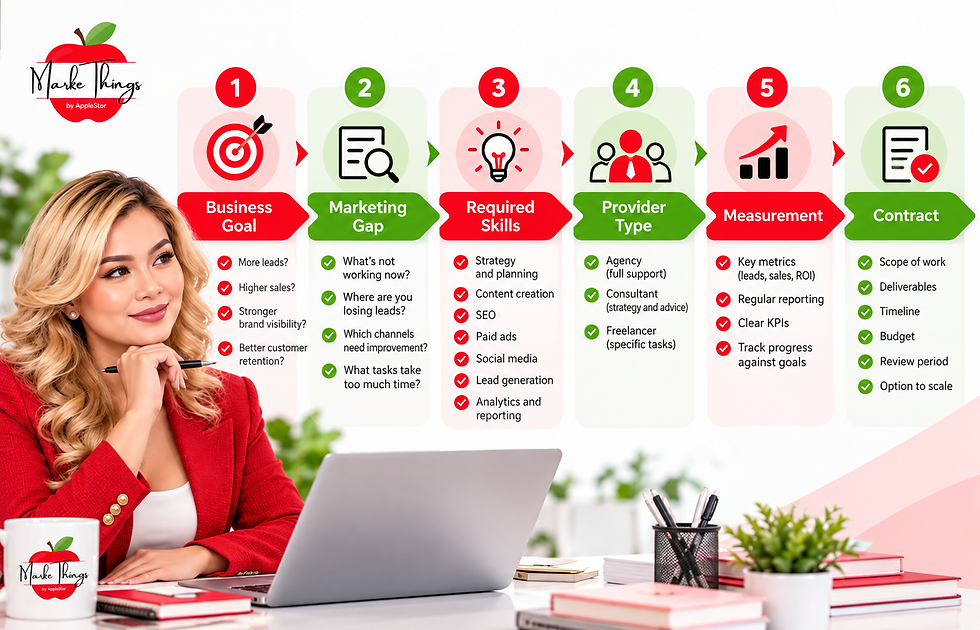
What Is the Difference Between a Digital Marketing Agency, Consultant and Freelancer?
The three options overlap, but they are not identical.
A digital marketing consultant generally focuses on strategy, diagnosis, planning and recommendations.
A freelancer usually provides specialist execution in a defined area, such as SEO, copywriting, design, paid advertising or social media.
A digital marketing agency typically provides multiple services and may coordinate strategy, execution, reporting and optimisation across several channels.
The important word is typically. Individual providers vary, so always examine the actual person or team you would be working with.
Option | Often suitable for | Potential limitation |
Consultant | Strategy, audits, planning, diagnosis | You may still need someone to execute the plan |
Freelancer | Specific specialist tasks | May not manage the wider customer journey |
Digital marketing agency | Multiple channels and ongoing execution | Quality and communication can vary between agencies |
Remote marketing team | SMEs needing coordinated ongoing support | Requires clear communication and onboarding |
In-house team | Businesses needing dedicated internal capability | Higher management and employment overhead |
The right choice depends on the gap inside your business.
A business with excellent marketing direction but no capacity to create content may need a freelancer.
A business spending money across several channels without a coherent strategy may need consulting or broader marketing support.
A growing SME that needs strategy, execution, reporting and coordination may need a connected marketing team.
This agency-versus-freelancer distinction is also explored in MarkeThings' guide to remote digital marketing support for Australian SMEs.
Step 1: Define What You Actually Need Help With
Before contacting providers, write down the problem.
Not:
“We need social media.”
Instead:
“We need a consistent social media system that builds trust and generates qualified enquiries from our target customers.”
That small change matters.
Your marketing problem might actually be:
poor search visibility
weak website conversion
inconsistent content
expensive advertising
low-quality leads
slow lead follow-up
unclear positioning
poor tracking
weak email nurture
disconnected marketing channels
lack of internal marketing capacity
You may discover that social media is not the primary problem at all.
A website can receive traffic without generating enquiries. An advertising campaign can generate leads that nobody follows up. SEO can increase visibility while the offer remains unclear.
More activity does not automatically solve the bottleneck.
💡 Helpful insight: Before hiring someone to fix a marketing channel, ask what happens immediately before and immediately after that channel in the customer journey.
Step 2: Decide Whether You Need Strategy, Execution or Both
This is one of the easiest ways to narrow your search.
If you need strategy
A consultant may be appropriate.
You might need:
a marketing audit
customer journey analysis
channel selection
positioning advice
campaign planning
SEO strategy
advertising strategy
conversion recommendations
measurement planning
If you need execution
A freelancer may be appropriate.
For example:
writing a batch of blog articles
designing social media graphics
editing video
conducting an SEO audit
setting up advertising campaigns
building landing page copy
managing a specific social account
If you need strategy and execution
An agency or remote marketing team may be worth considering.
This becomes particularly relevant when SEO, paid advertising, content, social media, email, automation, website optimisation and lead generation need to work together.
MarkeThings approaches this as an interconnected marketing system rather than treating every channel as an isolated task. Its digital marketing services cover areas including SEO, paid advertising, social media, content, email, lead generation, website optimisation and automation.
Step 3: Look for Relevant Experience, Not Just a Long Service List
A provider can say they offer 25 services and still not be the right fit.
Instead, ask whether they understand your type of business.
Relevant experience might include understanding:
your industry
your customer buying process
your geographic market
your sales cycle
your average customer value
your lead qualification process
your compliance requirements
your competitive environment
your marketing maturity
A coach, ecommerce company, recruitment business and local tradesperson may all need digital marketing, but their customer journeys can be completely different.
You do not necessarily need someone who has worked with your exact industry.
You do need someone capable of understanding the commercial mechanics of your business.
Step 4: Ask What They Would Do First
This is one of the most revealing questions you can ask.
Try:
“If you started working with us tomorrow, what would you check first?”
A thoughtful provider should want to understand the current situation before prescribing every service under the sun.
They may ask about:
business goals
target customers
current marketing
website
previous campaigns
analytics
lead sources
sales process
customer retention
competitors
budget
internal resources
HubSpot's client onboarding guidance similarly highlights the importance of gathering information about goals, target audiences, competitors, project requirements and communication preferences before work begins.
A provider who immediately says, “You need SEO, Google Ads, Instagram and TikTok,” without understanding your business may be selling a package rather than solving a problem.
Step 5: Ask Which Channels You Should Not Use Yet
This question is surprisingly useful:
“What should we not spend money on yet?”
Good marketing is partly about knowing what to do.
It is also about knowing what not to do.
You may not need every platform.
You may not need paid advertising before fixing your landing page.
You may not need five social platforms when your audience is concentrated on two.
You may not need more traffic when your enquiry process is broken.
You may not need another monthly content calendar if nobody has defined what
the content is supposed to achieve.
💡 Helpful insight: A provider willing to recommend restraint is often giving you more useful strategic information than one trying to sell you the maximum number of services.
Step 6: Ask How They Measure Success
This is where marketing conversations should become commercial.
Ask what they will report and why.
Useful metrics can include:
Business objective | Potential metrics |
Generate enquiries | Enquiries, qualified leads, conversion rate |
Improve paid advertising | Cost per lead, conversion rate, customer acquisition cost |
Improve SEO | Search visibility, relevant organic traffic, conversions |
Improve website performance | Conversion rate, enquiry actions, user behaviour |
Improve sales follow-up | Response time, qualified opportunities, close rate |
Improve retention | Repeat purchases, retention-related customer metrics |
Improve content | Relevant traffic, engagement, assisted conversions |
Impressions, reach, clicks and followers can be useful context.
They are not always the final business outcome.
Google's own Search Central guidance emphasises using Search Console and other tools to monitor search performance, while also warning against assuming individual technical metrics guarantee top search rankings.
The question is not simply:
“Did traffic increase?”
It is:
“Did the right people take a useful next step?”
Step 7: Check Who Owns Your Accounts and Data
Before hiring anyone, clarify ownership.
Ask:
Who owns the Google Ads account?
Who owns the Meta Business account?
Who owns the website?
Who owns the domain?
Who owns analytics data?
Who owns creative files?
Who owns the content?
Who controls passwords?
What happens if we stop working together?
You should understand the arrangement before handing over access.
A marketing relationship should not leave you wondering whether your business can access its own digital assets later.
Step 8: Understand Communication and Reporting
The right provider should make marketing easier to understand, not create another management job.
Ask:
Who is my main contact?
How often do we communicate?
What happens when something urgent occurs?
How are approvals handled?
Where are tasks tracked?
How often are reports provided?
Will strategy be reviewed regularly?
Who makes the final recommendations?
This matters particularly with remote teams.
Remote does not automatically mean disconnected.
A remote marketing partner can work well when expectations, communication, reporting and responsibilities are clear.
For international SMEs in Australia, the UK, Singapore, New Zealand, Dubai, UAE or elsewhere, the relevant question is not simply whether the provider has a local office.
It is whether the provider understands your market and can operate effectively with your business.
Step 9: Compare Proposals Based on Scope, Not Just Price
When you receive three proposals, resist the temptation to sort them from cheapest to most expensive.
Instead, compare what you are actually receiving.
Compare | Questions to ask |
Strategy | Is there a clear rationale behind the work? |
Scope | Exactly what is included? |
Execution | Who actually performs the work? |
Communication | Who will you speak with? |
Reporting | What will be measured? |
Optimisation | How will the strategy change based on results? |
Ownership | Who owns accounts and assets? |
Contract | What are the terms for changing or ending the engagement? |
Support | What happens between scheduled meetings? |
Commercial thinking | Does the provider understand leads and sales, not just activity? |
The cheapest proposal may not be the cheapest option once you factor in management time, poor execution, wasted advertising spend or disconnected services.
Likewise, a more expensive proposal is not automatically better.
Value depends on what your business actually needs.
MarkeThings' own FAQ makes a similar distinction: price should not be considered in isolation from clarity, accountability, execution, communication and ROI.
Step 10: Watch for Marketing Agency Red Flags
Be careful when a provider:
guarantees first-page Google rankings
promises instant growth
guarantees a specific number of leads without appropriate evidence
refuses to explain what they are doing
focuses entirely on followers or impressions
recommends every available channel
cannot explain how success will be measured
refuses to clarify account ownership
provides vague deliverables
hides the people doing the work
uses confusing reports
pressures you into a long contract before understanding your business
Google's Search spam policies also make clear that attempts to manipulate search visibility through prohibited practices can lead to search consequences.
Ethical marketing may not sound as exciting as “guaranteed number one rankings”.
That is usually a good thing.

Should You Hire a Freelancer or Digital Marketing Agency?
There is no universal answer.
A freelancer can be a sensible choice when you have one clearly defined need.
For example:
“We need someone to write 10 SEO-focused articles.”
Or:
“We need a paid advertising specialist to audit our existing campaign.”
An agency or connected remote marketing team may be more suitable when you need several functions coordinated.
For example:
“We need to improve SEO, advertising, content, website conversion and lead follow-up, but we do not have an internal marketing manager.”
The more specialists you hire independently, the more coordination you may need to do yourself.
That means the apparent saving can sometimes become a management cost.
Should You Hire a Marketing Consultant?
A consultant can be useful when the business has people who can execute but lacks strategic direction.
For example, you might have:
a social media assistant
a website developer
a sales team
an email platform
an advertising account
But nobody connecting the pieces.
A consultant can help determine priorities, diagnose problems and create a roadmap.
The important question is what happens after the roadmap is delivered.
A beautiful strategy document sitting in a folder is still a document.
It becomes useful when someone implements it.
When Is a Remote Marketing Team a Good Fit?
A remote marketing team can be useful when an SME needs ongoing marketing support without building a large internal department.
This can include coordinated support across:
SEO
content
paid ads
social media
email
lead generation
CRM
automation
website optimisation
reporting
For a remote arrangement to work well, establish clear communication, responsibilities, access controls, deadlines and reporting from the beginning.
MarkeThings positions its remote model around connected marketing support for SMEs and international businesses, including Australia, New Zealand, Singapore, Dubai, the UK and the Philippines.
What Should You Prepare Before Hiring Marketing Support?
You do not need a perfect marketing strategy before contacting a provider.
But you should be able to explain:
What your business sells.
Who you want to attract.
Where you currently get customers.
What marketing you are already doing.
What you believe is not working.
What you want to improve.
Your approximate available budget.
Who handles sales.
What systems you already use.
What access the provider may need.
The more useful information you provide, the easier it becomes for a consultant, freelancer or agency to recommend something relevant.
How Do You Know If a Digital Marketing Provider Is Working?
Look beyond activity.
Ask whether marketing is producing useful movement through the customer journey.
For example:
Visibility → Website visit → Enquiry → Qualified lead → Sales opportunity → Customer → Repeat customer
The exact journey differs by business.
A marketing provider should help you identify where customers are progressing and where they are dropping out.
MarkeThings' approach is to look beyond likes and impressions towards metrics such as qualified leads, cost per lead, conversion rate, customer acquisition cost, sales opportunities and revenue influenced by marketing where tracking allows.
💡 Helpful insight: Marketing does not end when someone fills in a form. If the lead is never contacted, qualified or followed up, the marketing system is incomplete.
What If You Are Not Sure What You Need?
Start with an audit rather than immediately signing a long-term agreement.
An audit can help establish:
what is already working
what is missing
where leads are being lost
which channels are underperforming
whether tracking is adequate
whether your website supports conversion
whether your marketing activity matches your business goals
MarkeThings describes its marketing process around audit, opportunity mapping, strategy, implementation, tracking and revenue alignment.
You can also review the MarkeThings FAQs for practical questions about agency selection, freelancers, remote marketing and marketing costs.
A Simple Digital Marketing Hiring Checklist
Before you hire anyone, make sure you can answer “yes” or “clear” to most of these questions:
I understand the business problem I am trying to solve.
I know whether I need strategy, execution or both.
The provider understands my target customer.
The provider has relevant experience.
They have explained what they would prioritise.
They have explained what they would not prioritise.
The scope is clear.
Deliverables are clear.
Reporting is clear.
Communication responsibilities are clear.
Account and data ownership are clear.
Contract terms are clear.
I understand how performance will be measured.
I know who will actually do the work.
I am comfortable asking questions before signing.
If several answers are unclear, slow down.
You are not buying a logo and a monthly report.
You are deciding who will influence part of your customer acquisition system.
AppleStar's Take
The question I would ask before hiring any digital marketing provider is simple:
“What problem are we actually paying this person or team to solve?”
Because marketing gets expensive when businesses buy activities instead of outcomes.
If your website is not converting, more traffic may not solve the problem.
If your leads are not being followed up, more leads may create a bigger backlog.
If your offer is unclear, more advertising may simply expose more people to the confusion.
And if nobody knows which numbers matter, another dashboard will not magically create clarity.
At MarkeThings, I look at the wider journey. I want to understand what attracts attention, what creates trust, what generates an enquiry, what happens after the enquiry and where customers are being lost.
That is why I do not believe every business needs every marketing service.
Sometimes the right answer is SEO.
Sometimes it is paid advertising.
Sometimes it is content.
Sometimes it is conversion improvement.
Sometimes the problem is actually sales follow-up or operations.
The job is to find the bottleneck before adding more activity.
Final FAQs
How do I choose the right digital marketing agency?
Choose a digital marketing agency that understands your business goals, target customers, marketing bottlenecks, measurement requirements and sales process, then gives you a clear strategy and scope.
Should I hire a digital marketing agency or freelancer?
Hire a freelancer when you need a focused specialist task, and consider an agency when you need multiple marketing activities coordinated under one strategy.
Is a digital marketing consultant different from an agency?
Yes. A consultant generally focuses more heavily on strategy, diagnosis and recommendations, while an agency typically provides a broader combination of strategy and execution.
How much does a digital marketing agency cost?
There is no universal price because cost depends on the market, industry, goals, competition, channels and level of support required. Compare scope and expected business value rather than price alone.
Can a small business hire a remote marketing team?
Yes. A remote marketing team can support an SME when communication, responsibilities, access, reporting and workflows are clearly established.
What questions should I ask before hiring a marketing agency?
Ask what they would audit first, which channels they recommend, what they would not recommend yet, how they measure success, who owns your accounts and data, who performs the work and how communication will work.
What are common red flags when hiring a digital marketing provider?
Common red flags include guaranteed rankings, instant-result promises, vague deliverables, unclear reporting, unclear ownership and recommendations made before the provider understands your business.
Should I choose the cheapest marketing provider?
Price alone should not determine the decision. A lower fee can still become expensive if the work creates poor-quality leads, wasted advertising spend, weak execution or additional management work.
How do I know if my marketing agency is working?
Look at business-relevant indicators such as qualified leads, enquiries, conversions, customer acquisition cost, sales opportunities and revenue influenced by marketing where reliable tracking is available.
Do I need to use every digital marketing channel?
No. The right channels depend on your audience, offer, buying journey, resources and objectives. A good provider should explain why a channel is appropriate before recommending it.
Should I hire a marketing VA instead?
A marketing VA can be useful for tasks such as scheduling, CRM updates, content support, reporting and administrative work, particularly when you already have a clear strategy and need execution capacity.
Can a freelancer manage my whole marketing strategy?
Some experienced freelancers can provide broader strategic support, but you should assess the actual scope, capacity and expertise rather than assuming that every freelancer can manage a complete marketing system.
Do I need a marketing audit before hiring someone?
You do not always need a formal audit, but reviewing your current website, marketing channels, tracking, customer journey and sales process can make the hiring decision more informed.
What should I give a marketing provider before they start?
Give them information about your business, customers, offer, goals, previous marketing activity, current systems, competitors and available resources. Access should be provided securely and only where necessary.
How long should I commit to a digital marketing provider?
The appropriate commitment depends on the work. Some projects are naturally short-term, while SEO, content, advertising optimisation and broader marketing systems may require ongoing work. Make sure the contract reflects the actual nature of the service.
Practical Next Steps
If you are currently comparing an agency, consultant or freelancer, do not start by asking:
“Who is the best?”
Start with:
“What does my business need right now?”
Then match the provider to that need.
If you need a specialist task, a freelancer may be appropriate.
If you need strategic diagnosis, a consultant may be appropriate.
If you need coordinated strategy and execution, an agency or remote marketing team may be appropriate.
And if you are not sure which category you need, that is useful information too.
Start with the problem.
Then find the person or team capable of solving it.
A Practical Marketing Audit Can Be the Starting Point
If you are unsure whether your biggest issue is SEO, advertising, content, social media, website conversion, lead generation, follow-up or something else, an audit can help you see the wider picture before committing to more marketing activity.
You can explore MarkeThings' digital marketing services, learn more about AppleStar, review available plans and pricing, or book a consultation.
The goal is not to buy the most marketing.
It is to build the right marketing system for the business you actually have.
AUTHOR
Apple Star Salvador, known professionally as AppleStar
Apple Star Salvador is the Digital Marketing Professional and Omnichannel Growth Strategist behind MarkeThings by AppleStar. She leads strategy, client communication, marketing direction, quality control and final decision-making for the founder-led marketing consultancy.
Her approach connects digital marketing with sales, customer acquisition, conversion, retention and operations rather than treating individual marketing channels as isolated activities.
SOURCES
MarkeThings and its published positioning, services and founder-led approach.
MarkeThings Digital Marketing Services, including its marketing process, services, reporting approach and international remote support.
MarkeThings FAQs, including agency selection, freelancer comparison, remote marketing and measurement guidance.
MarkeThings: Remote Digital Marketing Agency Australia, including agency, freelancer, VA and remote-team comparisons.
Google Search Central, for current Search and SEO guidance.
Google Search spam policies, for ethical search marketing considerations.
HubSpot client onboarding guidance, for onboarding, goals, communication and scope considerations.



Comments